
Sex Offender Checks in Hanover County
The Virginia State Police Sex Offender and Crimes Against Minors Registry is the authoritative Virginia search channel. Virginia State Police maintains the public Internet system and must update it each business day. The Hanover County Sheriff's Office does not publish a separate county registry. It registers and verifies people through the local law-enforcement process, while VSP manages the statewide public record.
A careful Hanover County sex offender check uses the state search first. Match more than a name when the profile provides enough facts. Review the conviction locality, offense description, age, address, and registration status. The record is designed for public safety awareness. It should not be read as a score of risk, and an address marker should not be treated as proof of conduct at that site.
Hanover Registry Duties Stay Local
State Police owns the public registry, but registration takes place through law enforcement. A person who establishes Virginia residence must register within three days. Some nonresidents who enter Virginia for an extended visit, work, or school must also register in person within three days. The Virginia registration procedure says initial registration uses SP-236, a ten-print fingerprint card, a palm-print card, and a color face-and-shoulders photograph. Reregistration uses SP-236A and thumbprints, while an address change uses SP-236 and a ten-print card.
Hanover County has no dedicated public appointment or fee page for this task. Registrants should confirm the current process before arriving at the Hanover County Sheriff's Office, 7522 County Complex Road, Hanover, VA 23069. The general line is 804-365-6110, and published weekday office hours are 8:00 a.m. to 4:30 p.m. The official records contact page is a useful route for current counter details, but callers should ask for the registration procedure rather than assume an ordinary records request applies.
Note: Hanover County performs local registration work, while Virginia State Police controls the official public registry and its online updates.
How to Search the Virginia State Police Sex Offender and Crimes Against Minors Registry
The live VSP interface was not reliably available during the official-source review, so exact button names, dropdown choices, distance ranges, and partial-name rules should be checked on the current screen. Do not assume a radius or map option exists. The documented functions include name and location searching, with city, county, or ZIP filters potentially presented by the live interface.
- Open the VSP registry and read the current conditions of use before searching.
- Select the available name or location route, then enter only the fields the live form requests.
- Use Hanover County, a local city, ZIP, or address control only if that exact option appears.
- Compare the result details and open the public profile that matches the known facts.
| Search Item | Type | Required | Confirmed Scope |
|---|---|---|---|
| Name search or name inputs | Mode/text | Check live form | Official function; exact labels not confirmed |
| Location or address search | Mode/text | Check live form | Exact fields and distance controls not confirmed |
| City, county, or ZIP filters | Filters | Check live form | Do not assume option lists |
| Search, clear, and disclaimer | Controls/notice | As displayed | Read current wording on the official screen |
When the official screen offers more controls than those listed here, follow its current labels and disclaimer. When it offers fewer, do not substitute a commercial map. VSP remains the source for a Hanover County registry result, even when location fields are limited.
Read Hanover Registry Results Carefully
Virginia Code § 9.1-913 sets the public profile's core scope. It includes the registered name and aliases, conviction date and locality, a brief offense description, age, current address, photograph, work address, and any institution of higher education where the person is enrolled. VSP can add other information it deems needed for public safety, including wanted-for-failure-to-register status. The live profile controls what is actually displayed.
Do not infer fields that were not confirmed. Vehicle information, marks or scars, a victim category, a detailed physical description, or a visible tier may appear in some registry designs, but those fields were not verified in the live Hanover County search environment. The statute-backed inventory is the sound baseline. VSP must remove information it knows is inaccurate, yet an apparent error should still be reported through official channels rather than corrected by public confrontation.
Inside a Registry Profile
A profile combines identification, conviction, location, and compliance information. Each field answers a narrow question. The conviction line identifies the registration basis; it does not describe present conduct. The current address reflects the registry record and should be checked against its update date or status where shown. Wanted-for-failure-to-register information is a law-enforcement status, not an invitation for a member of the public to act.
| Name & Aliases | The registered identity and other names listed by VSP. |
|---|---|
| Photo & Age | A public identification image and age supplied within the statutory profile. |
| Registered Address | The current address in the VSP record, plus work or school location when published. |
| Offense & Locality | A brief offense description with conviction date and locality. |
| Tier or Category | The legal classification when the current profile displays it. |
| Registration Status | Public-safety status, including wanted-for-failure-to-register information when applicable. |
The profile does not provide a complete court file or a general criminal history. Court orders and charging documents remain with the appropriate court, and VSP's registry serves the narrower registration purpose.
Hanover Registry Searches Across States
The National Sex Offender Public Website, operated by the U.S. Department of Justice, adds a cross-state layer. Its name route requires First Name and Last Name. Its location route uses Address, City/Town, and jurisdiction selectors. NSOPW draws from participating jurisdictions, so it is useful when the person or address of concern may connect to more than Virginia.
The official NSOPW search capture shows the national name and location routes.
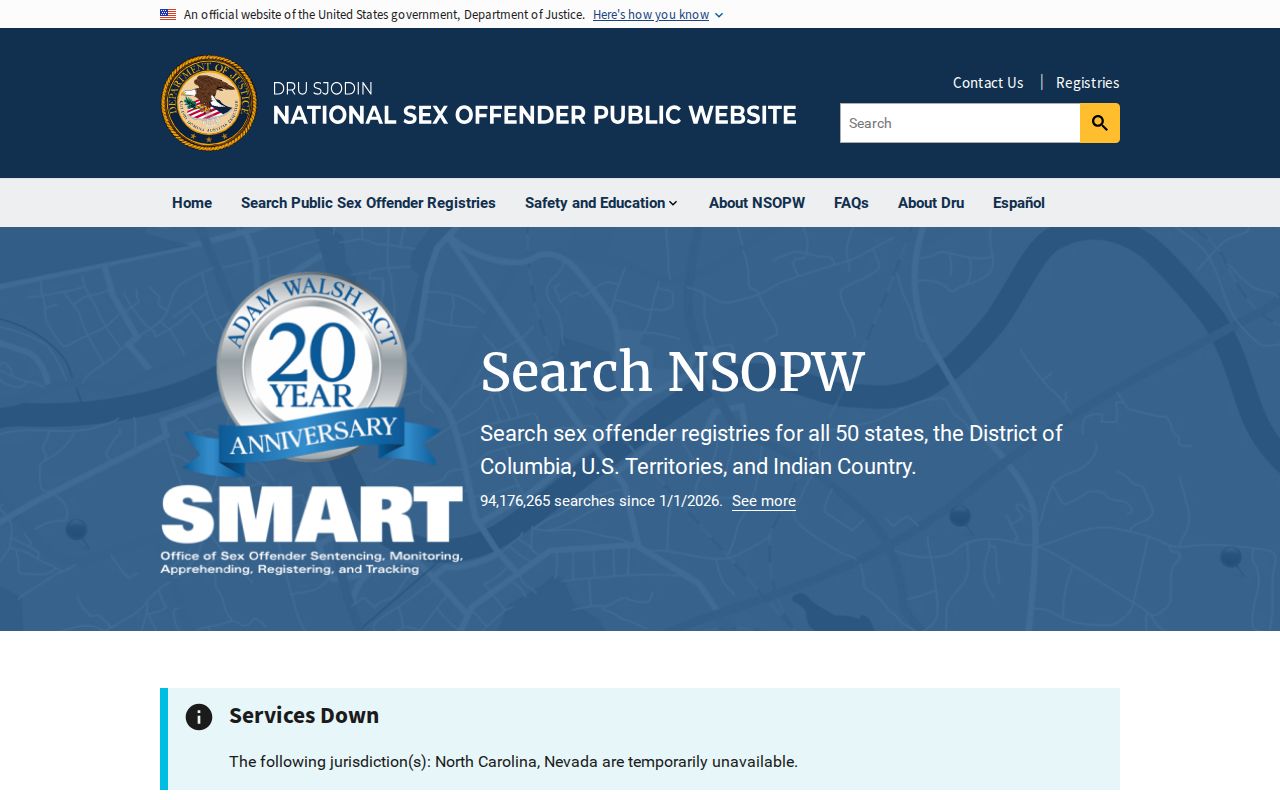
NSOPW warns that Virginia does not provide geographic coordinates to the national system. Coordinate-based location results may therefore be limited. Use VSP for the authoritative Virginia record, then use NSOPW as a supplement when the search crosses a state border.
Virginia Registration Levels and Requirements
Virginia uses Tier I, Tier II, Tier III, and murder as a separately referenced lifetime category. The law does not support a simple automatic 10-year, 25-year, or lifetime summary. Under § 9.1-908, registration generally continues until a court terminates it. Tier III, murder, and the former § 18.2-67.2:1 category carry lifetime duties. Time in confinement tolls an otherwise applicable period.
The Virginia Sex Offender and Crimes Against Minors Registry Act supplies the controlling tier and verification rules.
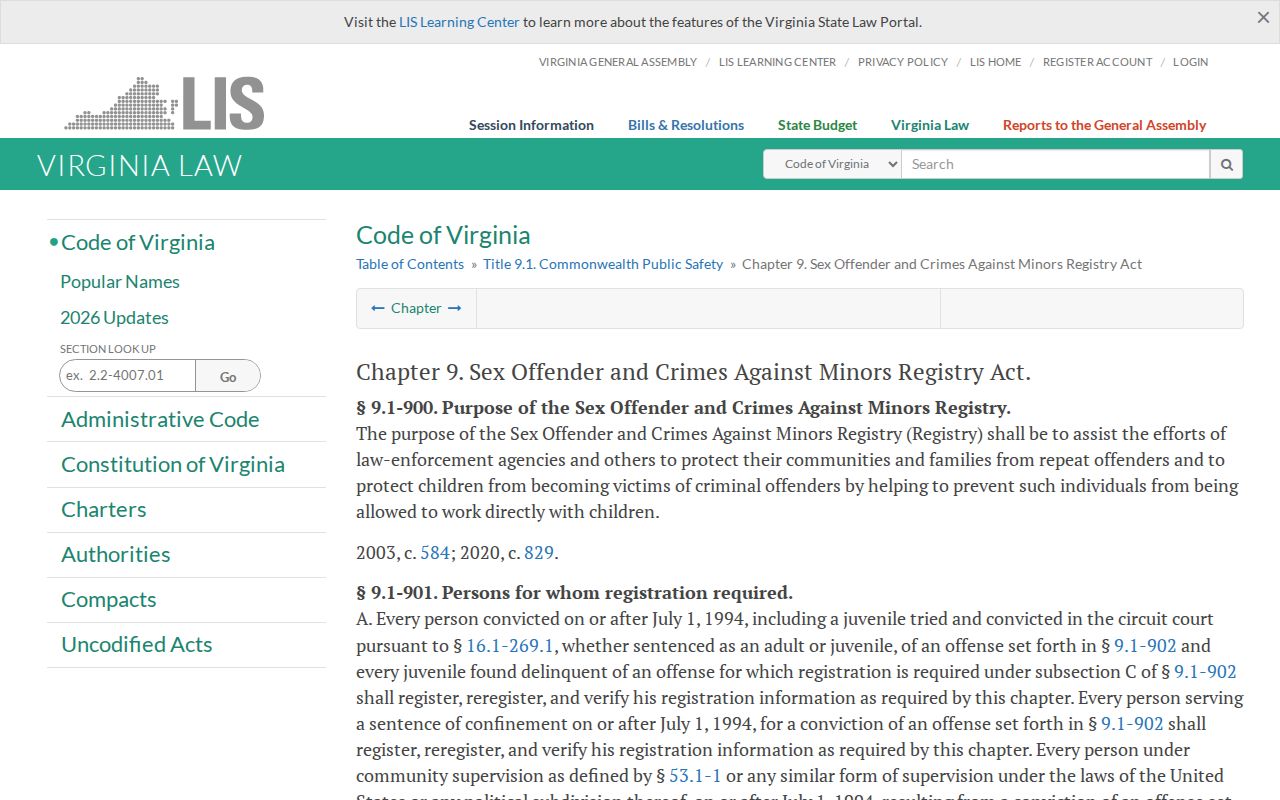
Those rules set how often a registrant verifies and whether a removal petition may be available.
| Category | Verification | Removal or Duration |
|---|---|---|
| Tier I | Yearly, including birth month | Qualifying single-offense petition no earlier than 15 years |
| Tier II | Yearly, including birth month | Qualifying single-offense petition no earlier than 25 years |
| Tier III | Every three months, including birth month | Lifetime; no § 9.1-910 petition route |
| Murder | Every three months | Lifetime |
| Tier I/II with failure-to-register conviction | Twice yearly | Underlying duration rule remains |
| Tier III/murder with failure-to-register conviction | Monthly | Lifetime duty remains |
Hanover Registry Verification and Removal
The verification calendar turns on both category and surname. Last names beginning A through L verify during days 1 through 15 of the relevant month. Last names M through Z verify from day 16 through the end of that month. A failure-to-register conviction can increase the frequency. This schedule explains why a Hanover County registry profile may reflect a recurring verification cycle rather than a one-time enrollment.
A qualifying Tier I single-offense registrant may petition no earlier than 15 years from the later statutory event. The comparable point for a qualifying Tier II single-offense registrant is 25 years. Removal under Virginia Code § 9.1-910 requires completion of ordered treatment, counseling, and restitution. The Commonwealth is a party at the hearing, and the court must find that the person no longer poses a public-safety risk. After a denial, another petition must wait at least 24 months.
Report Hanover Registry Discrepancies
An address that appears stale should be handled as a possible data or compliance issue, not as grounds for direct contact. First record the exact public profile and status shown by VSP. Check whether the issue may reflect a move, a timing gap, or a search mismatch. Then contact the Hanover County Sheriff's Office or Virginia State Police. The Hanover County government directory provides an official local fallback if an agency page or number changes. Law enforcement can compare registration records and decide whether follow-up is warranted.
Knowing noncompliance carries criminal penalties under § 18.2-472.1. A first Tier I or Tier II violation is generally a Class 1 misdemeanor, with a later violation treated as a Class 6 felony. Tier III or murder-category noncompliance is a Class 6 felony. Those rules belong to law enforcement and the courts. A member of the public should report facts and avoid confrontation.
Note: A public address concern should go to HCSO or VSP, since neither a map pin nor a search result proves noncompliance.
Community Notification and Lawful Use
Registry information supports awareness and practical safety planning. It may help a family understand the official public record near a known address or identify the proper agency for a concern. It does not authorize threats, intimidation, harassment, or self-directed enforcement. Reasonable republication without aggravating facts is not by itself intimidation, but the conduct and purpose still matter under Virginia law.
The official Virginia Code § 9.1-918 page sets the misuse rule.
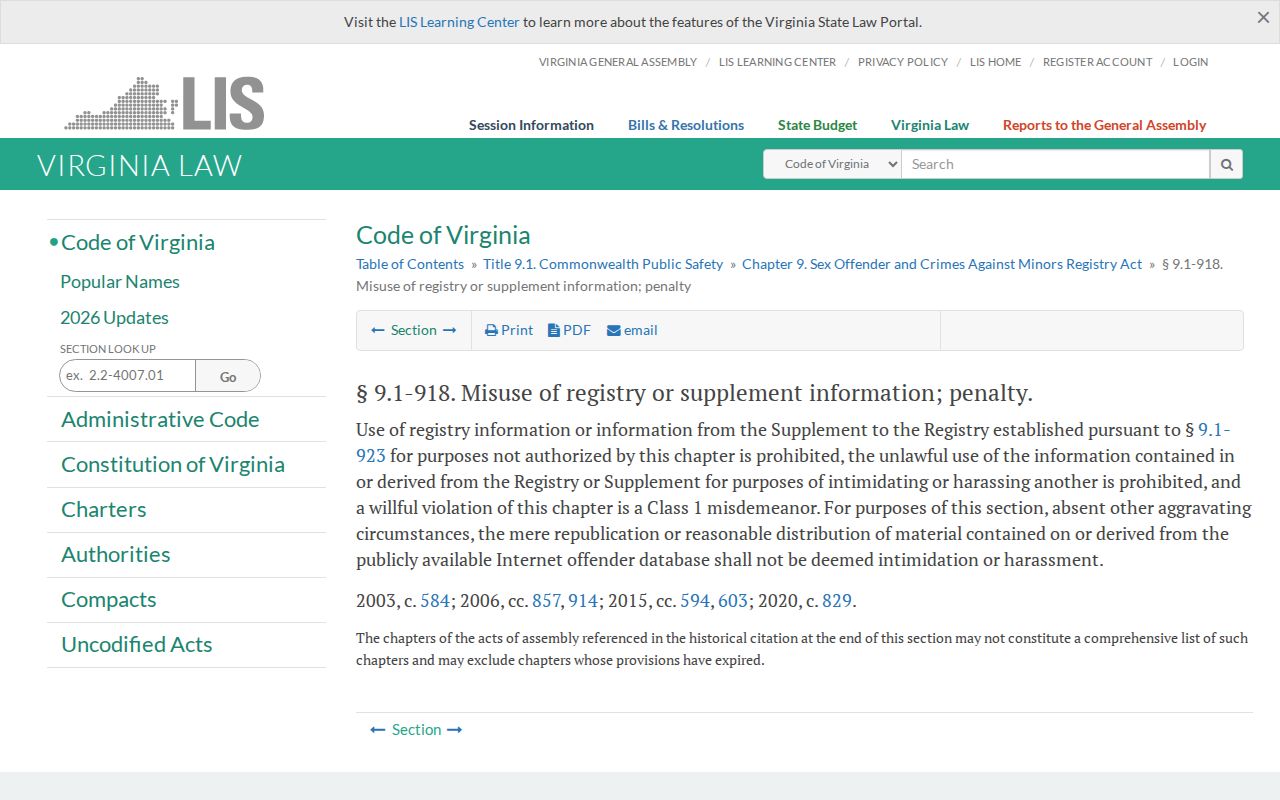
The statute makes a willful unauthorized use or qualifying intimidation and harassment a Class 1 misdemeanor.
Registry misuse is a crime: Virginia Code § 9.1-918 prohibits unauthorized use, intimidation, and harassment based on registry information. Report concerns to HCSO or VSP instead of confronting anyone.
Virginia law also allows a specific-person request to VSP or through local law enforcement under § 9.1-912. The official form asks for the reason, requester's name and address, subject name and address, Social Security number if known, and other identifying information VSP requires. The Superintendent may set a fee up to $15. This is a separate official channel, not a substitute for the public Hanover County registry search.